Why eating slowly changes what your gut tells your brain
Your fullness signals take 15-20 minutes to reach your brain. Here's the gut-brain lag that makes eating pace more useful than willpower.
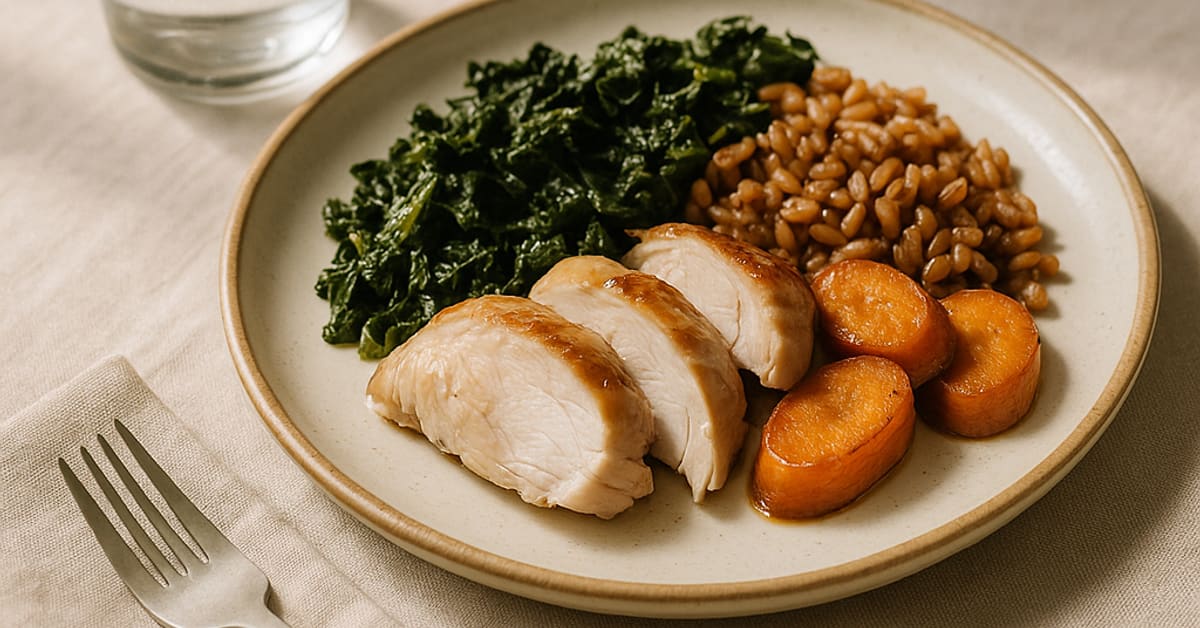
There's a delay built into your body's hunger system, and most people have never been told about it. Not because it's obscure science, but because the dominant conversation around food intake has always framed the problem as one of willpower — eat less, stop when you're full, practice self-control. What that framing skips over is the fact that the signals telling your brain you're full don't arrive in real time. They're more like a letter than a text message.
Understanding that delay doesn't just reframe how you think about eating pace. It gives you something concrete to work with.
The signals that say "enough" aren't triggered in your stomach
Most people assume fullness is registered when food fills the stomach. The stomach does play a role — stretch receptors send signals when it expands — but the more influential satiety signals, the ones that meaningfully tell your brain to stop eating, are triggered further down the digestive tract.
Two hormones are central to this: GLP-1 (glucagon-like peptide-1) and cholecystokinin, often abbreviated as CCK. Both are released primarily by cells in the small intestine in response to nutrients — particularly fats and proteins — making contact with the intestinal lining. GLP-1 slows gastric emptying and sends satiety signals to the brain. CCK signals the brain directly and also slows the movement of food out of the stomach, buying the body more time to process what's already there.
The critical detail: food doesn't reach the small intestine the moment you swallow it. It has to move through the stomach first, which takes time. Roughly 15 to 20 minutes passes between your first bite and the point at which meaningful amounts of nutrients are triggering those intestinal hormone responses.
What happens when you eat faster than the signal can travel
If a meal takes 10 minutes from first bite to last, the gut-brain satiety loop hasn't had time to close. The hormonal feedback that would normally inform how much food the brain registers as appropriate for this meal is still in transit. By the time GLP-1 and CCK levels rise enough to register as "enough," the meal is already over — or you've continued eating past the point the body would have suggested stopping if the signal had arrived on time.
This isn't a character flaw. It's a timing mismatch between a relatively modern eating pace and a signaling system that evolved over a much longer timescale. The gut-brain axis communicates through hormones and the vagus nerve, not through instant messaging. The lag is structural.
What this means in practice: eating quickly doesn't just mean eating fast, it means eating in a window that's too narrow for your body's feedback system to participate in the meal. The feedback arrives, but after the fact.
Why this matters more than portion size
Portion control as a strategy asks you to make a decision at the beginning of a meal about how much you should eat — before you've eaten anything. You're essentially trying to outsmart a system that's designed to give you information mid-meal. That's a hard problem to solve with pre-meal math.
Eating pace, on the other hand, works with the timing of the system rather than trying to override it. If you extend the duration of a meal to somewhere closer to 20 minutes or beyond, you create a window in which GLP-1 and CCK signals can arrive and influence the experience of the meal as it's happening. The brain gets to participate.
This doesn't mean slower eating guarantees any particular outcome — biology is variable, context matters, and meal composition also affects how quickly these hormones are released. A meal built mostly around refined carbohydrates and very little fat or protein will trigger a different hormonal response than one with a meaningful amount of both, regardless of pace. But pace determines whether the signaling loop gets to close at all during the meal.
What this looks like as a behavior, not a theory
The gap between understanding a mechanism and actually changing behavior at the table is real. "Eat slower" as advice has existed for decades and hasn't moved the needle much, likely because it's framed as discipline rather than information.
A more useful reframe: you're not trying to eat slowly. You're trying to stay in the meal long enough for your gut to send its first report.
Some behaviors that extend meal duration without requiring constant self-monitoring:
Putting utensils down between bites. Not forever — just for a moment. It introduces a small physical pause that slightly extends the time between swallows without requiring you to chew to a count.
Starting with foods that require more mechanical effort. Raw vegetables, whole grains, anything with structure takes longer to chew than soft or processed foods. A handful of raw carrots at the start of a meal does more to slow pace than reminding yourself to slow down mid-bite.
Eating without a competing task. Eating while working, scrolling, or watching something tends to accelerate pace because the eating becomes automatic. Removing the competing task doesn't guarantee slower eating, but it at least puts the meal back in your attention.
None of these are rules. They're levers. The goal is simply to widen the window.
How meal composition interacts with pace
Pace and composition aren't independent variables. The speed at which nutrients reach the small intestine depends partly on what those nutrients are. Fat and protein trigger stronger GLP-1 and CCK responses than simple carbohydrates, which means a meal with meaningful amounts of both will generate a more robust satiety signal even at the same eating pace.
A practical example: a lunch of white bread and low-fat deli meat eaten quickly is working against the signaling system in two ways — the meal composition triggers a relatively modest hormonal response, and the pace means even that modest signal arrives late. Swapping toward whole grain bread, adding a few slices of avocado, and eating 5 minutes more slowly changes both variables simultaneously. The gut has more to respond to, and more time to respond.
This is the kind of interaction that's useful to understand mechanistically rather than morally. It's not that white bread is bad. It's that different foods behave differently in the body, and those behaviors interact with each other and with the circumstances around eating — including how quickly you eat.
The real value of understanding the lag
Knowing that there's a 15-to-20-minute delay built into your gut-brain communication doesn't give you a hack. It gives you a mental model that makes a familiar behavior — eating pace — make sense in a new way.
Willpower as the explanation for overeating places the whole story inside a person's character. The gut-brain lag as the explanation places part of the story in the timing structure of a biological system. That's not an excuse — it's a more accurate map. And better maps tend to lead to better decisions, not because they motivate you more, but because they point you toward levers that actually connect to something real.
The next time you sit down to eat, you don't need to time yourself or count chews. You just need to remember that your gut is composing a message, and it needs about 20 minutes to send it. Whether you're still at the table when it arrives is up to you.