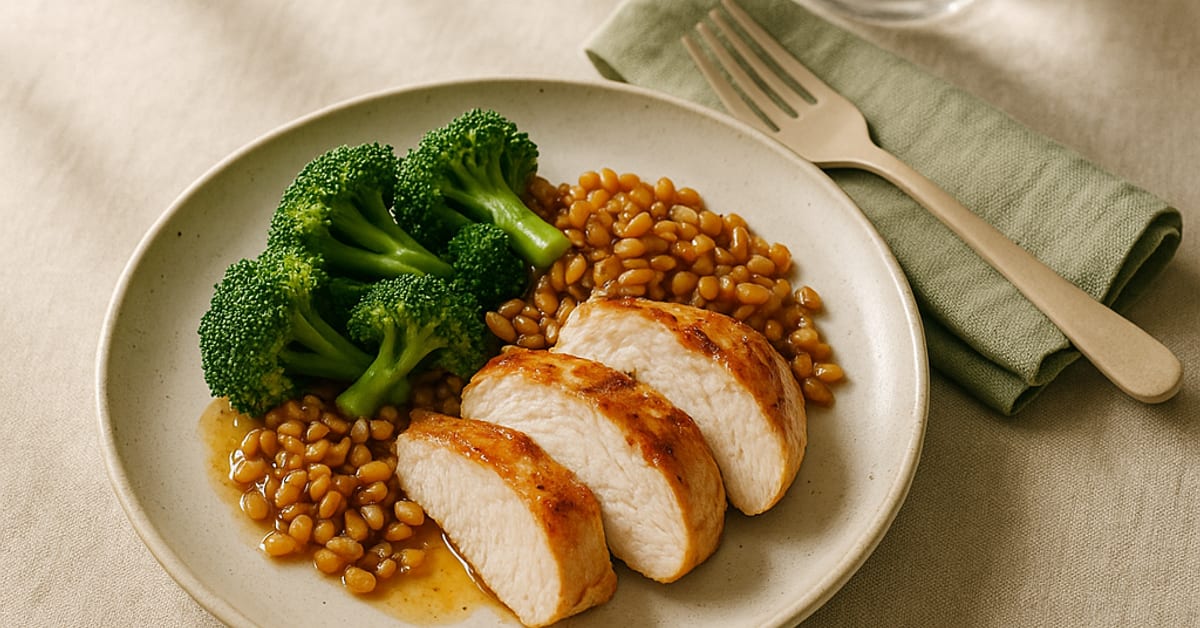
Why dim light changes what you choose to eat
Eating in low light does more than set a mood. Here's the mechanism behind why dim environments quietly shift your food choices before you notice.

Most of us have heard that we eat with our eyes. It sounds like a pleasantry — something a chef says before plating a dish with tweezers. But the phrase points to something real and underappreciated: the visual information your brain collects at the start of a meal is not decorative. It is functional. Your body uses it.
Change the lighting, and you change what that data says. The shift is quiet, it happens before the first bite, and research suggests it consistently nudges people toward denser, higher-calorie foods — without any sense that a nudge occurred.
The body prepares before you eat
When you sit down to a meal and look at your plate, a cascade of activity begins in the body that has nothing to do with chewing. This is called the cephalic phase response — cephalic meaning "of the head" — and it includes the anticipatory release of saliva, digestive enzymes, and insulin in response to sensory cues: smell, sight, expectation.
The visual portion of this response runs through a direct pathway between the visual cortex and the hypothalamus, the region of the brain that governs hunger, satiety, and hormonal signaling. When you look at food under good light, your brain gets a detailed read: color, contrast, texture, portion size, composition. That information travels fast, and the hypothalamus acts on it immediately, beginning to calibrate appetite and digestive readiness before anything reaches your stomach.
Think of it as your body running a preview. It sees what's coming and starts preparing. The accuracy of that preview depends heavily on what your visual system can actually pick up.
What happens when the light goes low
Dim lighting reduces what researchers call visual salience — the degree to which visual features stand out and register. Under low light, colors flatten, textures blur, and the detailed contrast between, say, a pile of roasted vegetables and a bowl of creamy pasta becomes much harder to read.
This matters because the cephalic phase response is partly keyed to that visual richness. When the signal is weaker — when your visual cortex can't deliver a high-resolution preview — the anticipatory hormonal response is dampened. Appetite-regulating signals like the early insulin release that helps buffer blood sugar from an incoming meal follow a different pattern.
Studies on eating in low-light environments consistently find that people consume more food overall and gravitate toward higher-calorie options. What's notable is not just the shift in consumption but the lack of awareness around it. People in dim settings tend to report similar satisfaction levels while having eaten meaningfully more, or having chosen differently than they might have predicted.
The environment did the choosing, quietly, before anyone picked up a fork.
Three places this plays out in ordinary life
This is not primarily a restaurant problem, though restaurants do use dim lighting deliberately — it slows eating pace, extends the visit, and, it turns out, may lower inhibition around indulgent choices. But most of the eating that matters for daily wellbeing happens outside restaurants.
The desk lunch is one common version. Eating at a workstation often means overhead lighting designed for screen use, not for assessing food. The meal gets peripheral attention at best. The visual preview is incomplete.
The sofa dinner is another. A plate balanced on a lap, lit mostly by a television or phone screen, in a room where the lamps have been dimmed for comfort. The food is technically visible. But the visual system is primarily engaged with the screen, not the plate, and the ambient light is doing little to sharpen the cephalic phase signal.
The late-night kitchen is a third. The overhead light might be on, but the surrounding darkness, the hour, and the often-absent deliberateness of the moment all reduce the quality of attention the visual system brings to what's on offer. This is why late-night eating so often involves denser, more calorie-concentrated foods — not purely because of willpower or hunger, but because the environment is biasing the choice before the choice feels like a choice.
Why this is worth understanding, not just knowing
There is a version of this information that leads to a simple rule: eat in bright light. That's not a bad outcome. But the more durable value of understanding this mechanism is that it reframes where food decisions actually happen.
Most of us locate food decisions in the moment of choosing — the menu, the grocery aisle, the snack drawer. But a meaningful portion of what shapes those decisions is environmental, pre-conscious, and running on pathways that were never designed for modern dining rooms, delivery apps, or screens.
The visual cortex sending appetite data to the hypothalamus is an ancient loop. It evolved in conditions where seeing food clearly was a prerequisite for deciding whether to pursue it. That loop still runs, in every meal, in every light condition. Understanding that it runs is the beginning of being able to work with it.
This is the kind of mechanism that Body Compass's Mechanistic Food Classification is built around — not the calorie count of a food in isolation, but how context shapes the way the body responds to food before, during, and after eating. Lighting is one piece of context. The way a food looks under it is another. These are not trivial variables.
A small shift worth trying
If you want to run a low-stakes experiment with this, pick one meal this week and give the environment a small upgrade: eat at a table rather than a desk or sofa, turn on a light that illuminates the plate directly, and put the phone face-down or out of reach for the duration.
You are not trying to change what you eat. You are trying to give your visual system a cleaner signal to work with and observe whether anything feels different — your pace, your awareness of what's on the plate, your sense of when you've had enough.
The goal is not to optimize every meal under laboratory conditions. It is to start noticing that conditions exist, that they vary, and that your body is reading them whether you are paying attention or not.
That noticing — slow, low-stakes, specific — is where most useful changes in eating behavior actually begin.