Why warm food fills you up faster than cold food
Temperature affects how satisfied you feel after eating. Here's the science behind warm food and satiety — and why it's not about metabolism myths.
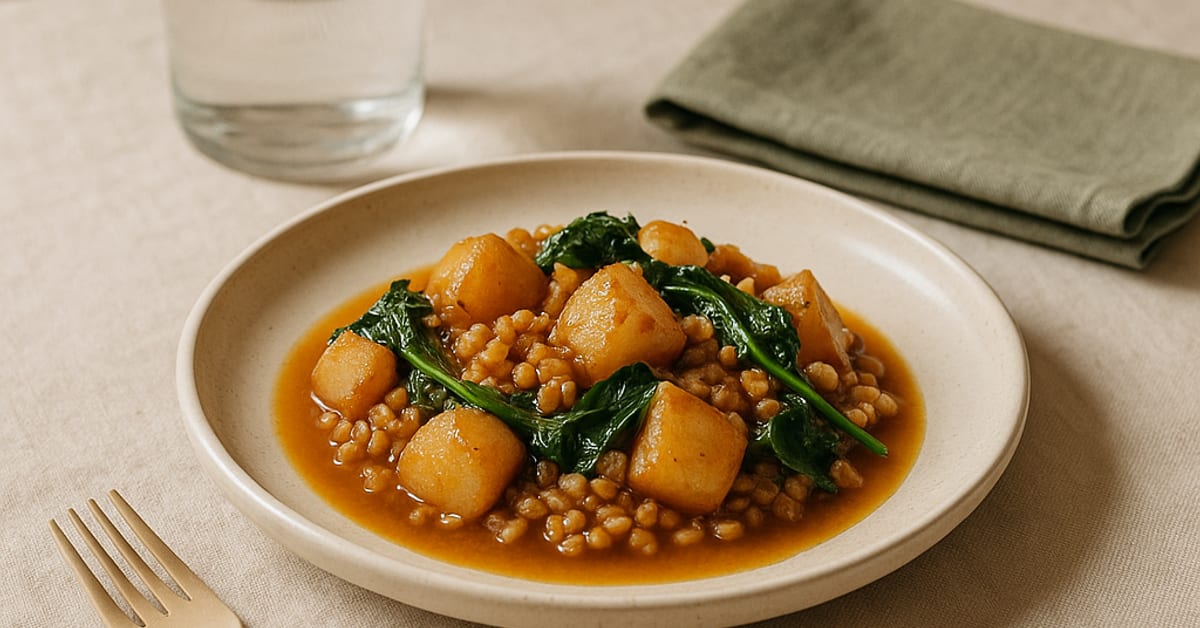
There's a reason a bowl of hot soup feels more filling than the same ingredients eaten cold from the fridge. Most people chalk it up to comfort, or habit, or the fact that they ate slower. But there's something more specific happening — something that starts in the gut before your brain has had a chance to weigh in.
Temperature is one of the most overlooked variables in how a meal registers as complete. Not because of the old myth about burning extra calories to warm up cold water — that effect is real but vanishingly small. The more interesting mechanism is sensory and hormonal: your gut has thermoreceptors, and what they detect changes how quickly your body sends the signal that a meal is done.
What thermoreceptors actually do
Your gastrointestinal tract is lined with sensory receptors that respond to more than just the chemical composition of food. Temperature is one of the inputs they track. When warm food arrives in the stomach, certain thermoreceptors — including members of the TRPV (transient receptor potential vanilloid) channel family — are activated. These receptors are sensitive to heat in the physiological range, and their activation is part of a broader signaling cascade that influences gut motility and the release of satiety-related hormones.
The short version: warm food stimulates the gut's sensory system more immediately than cold food does. That stimulation helps accelerate the feedback loop that tells your brain a meal has arrived and is being processed.
Cold food, by contrast, can slow gastric motility — the rhythmic contractions that move food through your stomach. When those contractions slow down, the stomach may not signal the small intestine to begin releasing satiety hormones like cholecystokinin (CCK) and GLP-1 as promptly. The same portion of food can linger in a kind of sensory limbo, processed but not fully registered as a complete meal.
The hormone timing gap
Satiety isn't a single switch. It's a sequence. First, the stomach stretches and sends mechanical signals. Then, as digestion begins in earnest, the small intestine releases peptides — CCK, GLP-1, peptide YY — that travel to the brain and accumulate into a sense of fullness. The whole process typically takes 15 to 20 minutes from the start of eating.
Warm food appears to compress the early part of that timeline. When thermoreceptors in the gut are engaged quickly, and when gastric motility is running at its normal pace, the hormonal cascade can begin earlier. That doesn't mean you'll feel full instantly — the 15-to-20-minute window still applies — but the signals start stacking sooner, which means they may reach threshold before you've added extra food to the equation.
With cold food, particularly meals eaten straight from the refrigerator, there's evidence that the initiation of these signals is blunted or delayed. The mechanical stretch still happens, but the thermoreceptor engagement is weaker, and gastric motility can slow in a way that spaces out the hormonal sequence. The result isn't necessarily that cold food is less nutritious or less satisfying in some moral sense — it's that the body's timing system runs a little differently, and that difference can show up in appetite.
A concrete example: leftover pasta, two ways
Consider the same portion of pasta with a tomato-based sauce. Eaten warm, the meal engages smell (which is more active with heat), taste (flavor volatiles are more available at higher temperatures), and the thermoreceptors in the gut as the food arrives. The full sensory picture is present.
Eaten cold from the container, the smell is muted. Flavor volatiles are less active. The stomach receives a chilled bolus that may slow its motility slightly. The hormonal feedback loop begins, but it starts from a different sensory baseline.
Neither version is a problem. But if you've ever eaten cold leftovers and found yourself wanting more food 20 minutes later — despite having eaten a full portion — this mechanism is a reasonable explanation. The meal was complete on paper. The body's registration of it was just a little slower to close.
This isn't about making rules
It's worth being clear about what this doesn't mean. It doesn't mean cold food is bad, or that salads are working against you, or that you need to reheat everything before eating it. Plenty of cold foods — a well-composed salad with substantial fat and protein, chilled legumes, cold-pressed vegetables — are satisfying in their own right, through other mechanisms like fiber content, water volume, and macronutrient composition.
What the temperature variable offers is a finer-grained lens on appetite. If you regularly eat quickly, or tend to feel hungry again soon after a meal, or find that certain lunches hold you and others don't — temperature is worth considering alongside the more obvious variables like protein content or meal size.
This is the kind of thing that's easy to test informally. Eat a warm version of a meal you usually have cold. Notice what's different about how the experience closes — not the moment of eating, but the 30 minutes after. That's where the signal shows up.
How food temperature fits into a bigger picture
Nutrition advice tends to focus on what you eat: the macros, the ingredients, the portion size. Less attention goes to the conditions under which food is eaten — temperature, pace, sensory context, time of day. These aren't fringe variables. They're part of how the body receives and registers a meal.
Mechanistic Food Classification, the framework built into the Body Compass app, is designed to account for exactly this kind of nuance. Rather than categorizing foods by calorie count or diet-label, it groups them by how they behave in the body — including how they interact with the gut's sensory and hormonal systems. Temperature is one of the inputs that shapes that behavior.
The Compass Framework™ that underlies the app treats these variables as levers, not rules. A lever is something you can choose to use or not, depending on context. Understanding that warm food tends to engage the gut's satiety signaling more quickly gives you one more lever — quiet, low-effort, and available at the next meal.
A place to start
If any of this has shifted how you're thinking about a meal you eat regularly, the most useful next step is observation rather than intervention. The next time you eat a lunch that usually leaves you reaching for something extra an hour later, notice whether it was warm or cold. Notice the pace. Notice how the experience of eating closed — or whether it felt like it didn't quite close at all.
You don't need to optimize anything yet. Curiosity about these mechanisms is already doing something useful: it's making the ordinary act of eating more legible. And legibility, over time, tends to lead to better choices — not because you followed a rule, but because you understood what was happening.